Goblin
Rock Falls, Everyone DiesGoblins are the recurring green humanoid inhabitants who provide the awakened stone with its first sustained field of conflict, its earliest victims, and the social reaction that marks it as something more than an ordinary weapon. Gathered for factional warfare, driven by old hatred, and alert to scarce magical tools, they become the first community to treat the stone simultaneously as projectile, treasure, threat, and opportunity.
Identity and Battlefield Setting
Goblins appear as small green figures with gleaming red eyes, assembled on opposing sides of a cliff with weapons aimed at one another. Their confrontation is already poised to become a battle when the falling stone strikes the ground and effectively serves as the opening shot. Warcries spread through the area, projectiles fly, and the goblins rush into one another while fury overwhelms judgment. The battlefield is therefore not merely a place where the stone happens to land; it is a concentrated site of grievance and vengeance, precisely the sort of violent current that can carry an object onward.
The goblins are materially disadvantaged compared with beings able to obtain enchanted equipment. When one of them notices the unusual stone, the attraction is partly practical: goblins are described as a poorer species and are not generally able to afford enchanted tools. Yet the stone’s value is also sensed socially and almost instinctively. After it has been thrown twice and claimed two lives, five goblins on the field are already watching the sixth goblin who picks it up, their sense of treasure alerting them that the object is special.
First Contact with the Rolling Stone
Grogg, a level 3 Skirmisher, becomes one of the clearest individual examples of goblin combat behavior. With an arrow embedded in his arm, he grits his teeth, rises, and is nearly struck by another arrow. His wooden spear remains useless because he cannot close the distance to enemies who continue attacking from range. Pain does not end his participation; it hardens into determination, and he throws himself down while cursing the opposing forces.
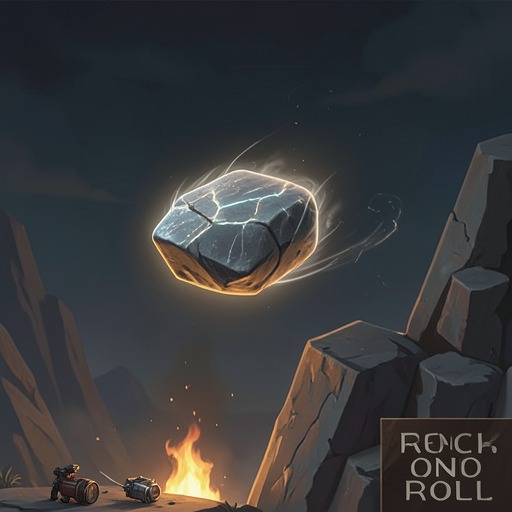
A wounded goblin near the stone later makes the decisive physical connection. Still clutching the arm pierced by an arrow, the goblin sees a rock of suitable size, picks it up, and throws it with relentless determination born from long-held hatred. That throw restarts the stone’s movement. The goblin does not understand that the object can steer, grow through impacts, or pursue an intention of its own, but the act nevertheless gives the stone the momentum it needs to resume its journey.
This encounter reverses the apparent hierarchy between wielder and weapon. The goblin believes it has selected a useful projectile; in practice, its act releases an increasingly self-directed force. The stone remembers the earlier rabbit encounter and recognizes that a first throw is enough to shift its momentum, allowing it to roll back toward a direction it already knows. Goblin violence thus becomes the mechanism through which the stone begins choosing its own path.
Treasure, Suspicion, and Competition
The stone’s second landing does not go unnoticed. Another goblin quickly rushes to pick it up, joining the chain of opportunistic handlers who see unusual potential in an object that has already killed. The watching goblins do not simply share a communal discovery. They observe one another, measuring who controls the treasure and whether the next holder will survive using it.
Kabab the mighty embodies this competitive response. A heavily muscled goblin, he declares that he will slay every foe and prepares to throw, flexing as though physical strength can guarantee mastery of the object. Unlike the eager hand reaching from beneath a shield, Kabab has noticed what happened to the previous thrower and acts more cautiously. He activates the skill called “Boomerang throw!” so that the stone, after striking the ground, accelerates back toward him.
The skill does not make Kabab master of the stone. It instead produces a contest between a goblin’s tactical knowledge and the stone’s growing independent behavior. The object’s velocity falls to zero when its damage is blocked, but its motion soon resumes under the boomerang effect. Goblin ingenuity can redirect the encounter without controlling its outcome, and the unusual weapon remains the decisive actor in the exchange.
The Warpath and the Dungeon Invasion
After the battlefield conflict, Kabab stumbles forward with ten arrows embedded around him and finally finds the stone of his victory. He raises it toward a sky glittering with a new moon and interprets his possession of it as a divine blessing, beginning to proclaim a new life as King Kaba. The moment captures the goblin tendency to convert survival and possession into a claim of status. Kabab sees a miraculous royal emblem; the stone sees a possible period of service and a chance for further levels.
The relationship does not last. Once the stone realizes that it needs more power and that levels are power, it notices green figures ducking into cover high on the mountain. Remembering its earlier meeting with goblins as an unwilling projectile in someone else’s war, it steers toward them. This time the violence is not an accident of battlefield momentum. The stone chooses a warpath of its own, converting the goblins from agents who launch it into targets it deliberately pursues.
One goblin attempts to escape into the depths of a pit and experiences the stone as a persistent terror. After five minutes without seeing it, he is still shaken and jittery, believing he has finally escaped. A shadow suddenly appears above him, followed by the stone’s impact. The encounter demonstrates that distance and temporary concealment do not end the threat: the stone can wait, steer, and return, while the goblin’s fear continues even during the interval in which nothing visibly happens.
The ensuing dungeon invasion places the goblins within a larger chain of consequences. The dungeon reacts to the presence of an intruder, and a mass of skeletons advances through the corridors. The stone crashes through the undead, dealing 286 damage to four generic skeleton mobs while maintaining a velocity of 26.7 meters per second. The goblins are no longer the only beings affected by the stone’s growth, but their earlier attempts to throw, seize, evade, and exploit it form the immediate history that made its later destructive momentum possible.
Narrative Significance
Goblins are the first organized society to recognize the stone as valuable before the wider world can identify its nature. Their poverty explains why an apparently ordinary rock becomes worth fighting over, while their battlefield behavior supplies the hatred, momentum, and repeated handling through which the stone develops agency. They are neither passive victims nor fully informed opponents: they make tactical choices, notice patterns, use skills, and pursue advantage, yet each attempt to use the stone also enlarges the danger they are trying to control.
Their encounters establish a recurring contrast between humanlike intention and nonhuman persistence. A wounded goblin throws because hatred demands action; Kabab throws because strength and skill seem to promise mastery; a fleeing goblin hides because survival appears possible. The stone answers each motive with the same cold continuity of motion, but it is no longer merely being carried by events. Through the goblins, the story marks the transition from an object caught in violence to an actor that remembers violence, selects targets, and turns the social hunger for treasure against those who first gave it movement.